Statistical Mechanics
The Ising Model and Phase Transitions
Spins on a lattice. Whether a phase transition happens at all turns on the dimension.
Updated May 2026
Strip magnetism down until nothing is left but the essential and you get the Ising model: spins on a lattice, each preferring to agree with its neighbours.
The first term is the interaction, summed over neighbouring pairs; the second is an external field. That is the entire model, and it is still not fully solved in three dimensions.
The competition
Every phase transition is the same argument. The free energy is
and the two terms want opposite things. Energy is minimised by order, with all spins aligned. Entropy is maximised by disorder, with spins arranged every which way, of which there are vastly more configurations. Temperature sets the exchange rate.
At low the energy term wins and the system magnetises. At high the entropy term wins and it does not. Somewhere between, they trade places, and that is the critical temperature.
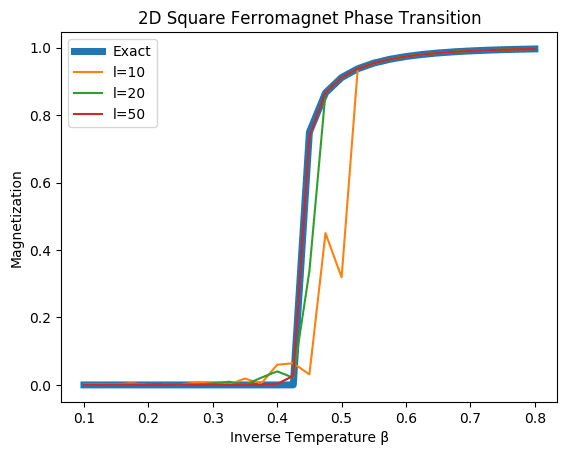
The order parameter vanishes continuously at but with infinite slope, the signature of a second-order transition. There is no latent heat and no coexistence.
Dimension decides
Result
One dimension: no transition
Peierls' argument. In a chain, breaking the ordered state costs a fixed energy for a single domain wall, but the wall can sit in any of places, giving it entropy . The free energy change is , which is negative for any once is large. Order is destroyed at every finite temperature.
Result
Two dimensions: Onsager
In two dimensions a domain wall must be a closed loop, and its energy grows with its length. Entropy no longer wins automatically. Onsager solved the model exactly in 1944 and found
It remains one of the very few exactly solved interacting models in physics.
The lesson generalises well beyond magnets: whether a system can order depends on the dimensionality of the space it lives in, because dimensionality controls how much entropy a defect can carry.
Mean field theory, and its honest failure
Replace each spin's neighbours by their average and the model becomes self-consistent:
with the coordination number. Expanding near gives and .
The structure is right and the numbers are wrong. Mean field predicts a transition in one dimension, where there is none. It gets where the exact two-dimensional answer is . The approximation throws away fluctuations, and near a critical point fluctuations are the entire story. Correlation lengths diverge and the "average neighbour" stops meaning anything.
Universality
The exponents are where this stops being a model of magnets. Near ,
with . These exponents do not depend on the lattice, or on , or on the microscopic details at all. They depend only on the dimension of space and the symmetry of the order parameter.
A uniaxial ferromagnet, a liquid–gas critical point, and a binary alloy unmixing have nothing physically in common and identical critical exponents. Accounting for that is what the renormalisation group does, by showing that the microscopic differences are exactly the ones that stop mattering as you coarse-grain.